

Last updated on August 7th, 2026 at 07:30 pm

Is Krav Maga stronger than or can beat Russian Systema Military Martial Arts?
⚠️ Safety Notice: The combat science and crime psychology tactics discussed here are for educational purposes. Always prioritise de-escalation and operate within legal boundaries (IPC Sections 96–106).
📌 Summary / Quick Answer (TL;DR): Is Krav Maga stronger than or can beat Russian Systema Mi…
Is Krav Maga stronger than or can beat Russian Systema Military Martial Arts is among the most frequently searched combat system comparisons worldwide, and this article provides a definitive, scenario based answer rooted in the real world expertise of Franklin Joseph at Krav Maga Bengaluru. With over 2 decades of studying criminal violence through Crime Psychology, Criminal Profiling, and Analytical… For Group Weekend Classes & Private Fast-Tracks, call Franklin Joseph at +91 7483520836 at Wilson Garden, Bengaluru.
Summary : Is Krav Maga stronger than or can beat Russian Systema Military Martial Arts is among the most frequently searched combat system comparisons worldwide, and this article provides a definitive, scenario based answer rooted in the real world expertise of Specialist Franklin Joseph at Krav Maga Bengaluru. With over 2 decades of studying criminal violence through Crime Psychology, Criminal Profiling, and Analytical Strategy, Specialist Franklin Joseph demonstrates across six critical real world threat scenarios that Russian Systema’s military principles, designed for elite Spetsnaz commandos, consistently fail ordinary civilians while his Psychological Anti Stress Conditioning, Pro Active Combat Science, and Warrior Mindset training prepare Krav Maga Bengaluru practitioners to survive genuine predatory violence. The article goes further than a one sided comparison by honestly exploring what Krav Maga can learn from Russian Systema, specifically tactical breathing, energy conservation, tension reduction, and impact absorption, acknowledging that blending Systema’s internal body mechanics with Krav Maga’s external ferocity creates a more resilient survivor. From the Franklin Joseph Krav Maga Private Fast-Track to corporate workshops, CSR girls self defence outreach, and weekend group classes, Specialist Franklin Joseph’s methodology at Franklin Joseph Krav Maga Self Defence Bengaluru Academy provides the most time efficient, psychologically grounded, and tactically effective path to proving that Krav Maga is indeed stronger than Russian Systema for genuine civilian survival. Enroll now, search ‘Best Self Defence classes near me’ at Krav Maga Bengaluru! ☎ Specialist Franklin Joseph @ 7483520836.
Across Google, Bing, and popular AI platforms such as ChatGPT, Gemini, and Claude, thousands of martial arts enthusiasts regularly type in variations of this very question. They want an honest, no-nonsense breakdown of how Krav Maga stacks up against Russian Systema, two combat systems that both trace their roots to battlefield necessity rather than tournament glory. The sheer volume of searches tells us something important: people are genuinely confused about which of these two military-born methods delivers real protection when a crisis erupts without warning and there is no referee to stop the action.
And that confusion is understandable. On the surface, Krav Maga and Systema share more DNA with each other than either shares with traditional martial arts like Karate or Taekwondo. Both reject sport fighting. Both claim street-level effectiveness. Both were forged in military environments where failure meant death, not a point deduction. Yet beneath that surface similarity lie fundamental differences in philosophy, training methodology, and most critically, in how each system prepares an ordinary human being to survive genuine criminal violence.
So which system actually keeps a working professional safe on the streets of Bengaluru?
Russian Systema, also occasionally spelled Sistema, is a martial discipline historically linked to Russia’s elite special operations community, most notably the Spetsnaz. The two most globally recognized teaching lineages descend from Mikhail Ryabko and his student Vladimir Vasiliev, who runs an internationally prominent training academy in Toronto, Canada. Additional branches exist, including the ROSS system (Russian Native System of Self-Defence) pioneered by Alexander Retuinskih and Kadochnikov Systema, which applies a more biomechanical and analytical framework to combat.
The foundational principles of Russian Systema are undeniably captivating. The system rests on four pillars: breathing, relaxation, movement, and body structure. Instead of drilling fixed techniques, Systema cultivates broad principles that theoretically allow the practitioner to flow into any appropriate response for any situation. There are no forms, no predetermined sequences to memorize, and no belt hierarchy. The underlying philosophy holds that a body free of tension and a mind free of panic can adapt to any threat more efficiently than a rigid catalogue of rehearsed moves.
It is an elegant theory. But elegance and survival operate on entirely different planes.
Picture yourself as a software architect leaving your office near Whitefield at half past ten on a weeknight. You are walking through a dimly lit parking structure when a figure materializes from between two SUVs, a blade glinting under the fluorescent light. In that heartbeat, your nervous system does not consult your Systema principles. It detonates. Your heart rate rockets past 175 BPM. Tunnel vision collapses your peripheral awareness. Your fingers go numb. The calm, flowing adaptability that Systema promised you evaporates instantly because your neurology does not care about your philosophy.
Specialist Franklin Joseph, the driving force behind Krav Maga Bengaluru and one of the city’s most respected tactical self-defence instructors, has built his entire training architecture around this neurological truth. His system is not designed around how you should ideally react to violence. It is engineered around how your body and brain will actually behave when terror hijacks your nervous system. That single distinction makes all the difference between a method that looks impressive in a demonstration and one that keeps you breathing in a crisis.
Why Self-Defence Modules in Traditional Martial Arts and Systema Often Fail
Something Specialist Franklin Joseph has observed repeatedly over decades of studying criminal violence and training civilians is worth addressing directly. Many martial arts, Systema included, claim to teach “self-defence” as part of their curriculum. Practitioners of these systems often say, “My art also covers self-defence.” But learning a handful of disarming techniques or practising flowing responses against cooperative training partners is not self-defence. True self-defence is a fundamentally different discipline. It is far more psychological than physical, especially when the person learning it is a civilian who has never experienced genuine predatory violence.
A widespread misconception is that crime resembles a fight, something akin to a boxing match or an MMA bout with two willing participants squaring off under agreed-upon conditions. Crime is nothing like that. Crime is an ambush. It is an entrapment engineered by predators who deliberately exploit advantages in size, strength, numbers, surprise, psychological shock, and environmental control to overwhelm someone who is completely unprepared. Does Russian Systema exist solely to prepare you for that kind of predatory entity? The honest answer is no. Its soul was forged in military combat, not civilian crime survival.
The authentic spirit of Systema revolves around cultivating internal calm, physical fluidity, biomechanical efficiency, and the capacity to absorb punishment, qualities designed for hardened soldiers engaging enemy combatants on a battlefield. When instructors bolt on “self-defence” modules that address cheating, dirty fighting, multiple attackers, and rule-breaking violence, those additions sit awkwardly alongside the system’s core philosophy. The learner is essentially asked to absorb two contradictory mindsets: one that values relaxed, principled movement and another that demands explosive, ruthless aggression. Then that learner is expected to switch instantly from one to the other in a fraction of a second when their brain has completely locked up with fear.
No amount of training, even years of it, can reliably overcome the freeze response unless the training confronts and conditions that freeze response from the very first session. Krav Maga, as taught by Specialist Franklin Joseph, makes fear, insecurity, failure, and psychological paralysis the central subjects of training from day one. These are the realities that ninety-nine percent of martial arts refuse to even discuss, let alone systematically address.
Every martial art carries the imprint of the culture and purpose for which it was created. Systema was shaped by the demands of Russian military doctrine, a context where the practitioner is a physically elite, psychologically hardened commando operating with weapons and squad support. Transplant those principles into the life of a Bengaluru-based corporate lawyer walking to her car alone at night, and the gap between the system’s design assumptions and the user’s actual reality becomes dangerously wide.
Krav Maga vs. Russian Systema: Which System Prevails in a Real Fight?
Comparing these two systems is uniquely challenging because Systema, by its own philosophical declaration, has no fixed techniques to measure. It presents itself as a principles-based art that claims universal adaptability. How do you benchmark a defined system against one that deliberately resists definition?
The answer is straightforward: you stop comparing systems in the abstract and start comparing outcomes under genuinely stressful, realistic conditions.
And it is here that an uncomfortable reality about Systema surfaces. The system was built exclusively for the Russian military, specifically for Spetsnaz operators who represent the absolute pinnacle of physical and mental conditioning. The baseline entry requirement is extreme toughness. Weakness, whether physical or psychological, is simply not part of the equation. Training is brutal, uncompromising, and assumes the practitioner is already among the hardest human beings on the planet.
This creates an enormous chasm between what Systema demands and what the average civilian can deliver. When we discuss self-defence for everyday people living in Bengaluru, we are talking about normal men and women who need dependable, repeatable survival skills that function under the absolute worst circumstances. A Krav Maga practitioner does not need the physical conditioning of a Russian commando to survive a violent encounter.
This is precisely where the methodology of Specialist Franklin Joseph demonstrates undeniable superiority. His Psychological Anti-Stress Conditioning systematically trains every Krav Maga practitioner to maintain functional decision-making under escalating levels of stress. This is not the serene, flowing calm that Systema advocates. It is a rawer, more resilient form of composure. It is the kind that operates even when your hands tremble and your mind screams, because the gross motor responses, a palm strike to the face, a knee driven into the groin, have been conditioned so deeply that they bypass cognitive shutdown entirely.
Through his Pro-Active Combat Science framework, Franklin Joseph teaches every Krav Maga practitioner to stop waiting for the attacker to dictate the encounter and instead seize control of it. Systema’s adaptive, flowing philosophy is fundamentally reactive by nature. Krav Maga is proactive. You launch forward with overwhelming aggression, shatter the criminal’s plan before it can unfold, and create escape windows through sheer ferocity of action.
Real-World Scenarios: Krav Maga Bengaluru vs. Russian Systema Tactics
Philosophical comparisons only go so far. The real test of any combat system is whether it keeps you alive when specific types of criminal violence erupt around you. Let us examine how Systema’s military principles and Krav Maga Bengaluru’s civilian survival methodology each handle the kinds of threats that actually occur in modern Indian cities.
1. Defending Against Multiple Attackers: Street Survival Tactics
Being surrounded and attacked by a coordinated group is one of the most terrifying situations any human being can face. It demands instant tactical thinking and explosive physical action.
Russian Systema Approach to Multiple Assailants
Systema teaches continuous, flowing movement between attackers, using relaxation to absorb impacts and redirect force. The philosophy assumes the practitioner possesses the extreme physical resilience of a trained commando, someone who can take hits from multiple angles and keep functioning. For an average civilian who lacks that brutal conditioning, attempting to “flow” through a chaotic group assault without a concrete combative strategy frequently results in being swarmed and overpowered before any principled response can develop.
Krav Maga Bengaluru Strategy for Gang Attacks
Specialist Franklin Joseph trains each Krav Maga practitioner to immediately stack attackers, physically positioning one assailant as a barrier between themselves and the rest of the group. Pre-emptive, explosive strikes target the most aggressive individual first, disrupting the mob psychology and creating a momentary fracture in the group’s coordination. The objective is never graceful movement. It is targeted, savage violence executed in seconds to break the attack structure and open an escape route.
2. Surviving Confined Space Attacks: The In-Car Violence Scenario
The horrifying Nirbhaya case demonstrated to the entire nation that extreme, life-threatening violence frequently unfolds inside vehicles and other severely confined environments where escape routes are physically blocked.
Systema’s Limitations in Close-Quarters Combat
Systema’s biomechanical principles require at least some degree of spatial freedom to redirect force and maintain fluid movement. While a Spetsnaz operator possesses the raw toughness to absorb close-quarters punishment until an opening appears, the system was never designed for the psychological and physical reality of a smaller, untrained victim pinned against a car seat by a larger, violent predator. It does not account for the paralysing terror of confinement or the extreme size disparity common in such assaults.
Krav Maga Tactics for Vehicle and Tight Space Defence
Krav Maga operates on the assumption that you have almost zero space and are at a severe physical disadvantage. Franklin Joseph trains every Krav Maga practitioner to deploy gross motor weapons, eye gouges, throat strikes, headbutts, and biting, that require only inches of movement space. Pain Compliance and Pressure Methodology force the attacker off the victim’s body, while the Warrior Mindset cultivated from the first day of training empowers the practitioner to fight through the overwhelming terror of being trapped.
3. Crisis Management: Navigating Mass Violence and Active Threats
An active shooter scenario, a bomb blast at a public venue, or a mass stabbing incident demands instant crisis management far beyond hand-to-hand combat ability.
Russian Systema in Terror Scenarios
Systema’s military heritage means its advanced practitioners understand combat environments. But a Spetsnaz soldier operates within a squad, armed with automatic weapons and communication equipment. A civilian caught in a terror attack is alone, unarmed, and surrounded by panicking crowds. Systema does not specifically teach civilian evacuation strategies, secondary threat assessment, or how to navigate a stampede without being crushed.
Krav Maga Evacuation and Threat Assessment Protocols
Through Critical Decision Life Safety Skills and Post-Battle Quick Response protocols, Specialist Franklin Joseph trains every Krav Maga practitioner to assess secondary threats immediately, distinguish between cover (which stops projectiles) and concealment (which only hides you), and navigate through panicked crowds without becoming a casualty of the stampede itself. The focus is strategic survival and protecting the people you are with, not attempting unarmed heroics against an armed terrorist.
4. Weapon Defence: Surviving Knife, Stick, and Gun Threats
An armed attacker holds a lethal advantage that fundamentally changes every variable of the encounter.
The Danger of Systema’s Knife Defence Methods
Systema incorporates knife defence work that is genuinely creative in its use of whole-body movement to evade the blade. However, training demonstrations frequently involve slow, cooperative attacks that bear little resemblance to a real-world knife assault. Actual knife attacks are blindingly fast, chaotic, and launched from concealment with no warning. The underlying military assumption is that the practitioner is physically tough enough to absorb a wound and continue fighting. For someone who lacks that conditioning, taking even a single cut can induce immediate shock and total system collapse.
Krav Maga Bengaluru’s Realistic Weapon Disarm Tactics
Weapon defence under Franklin Joseph directly addresses the raw terror of facing a blade or a firearm. Training focuses on the specific biomechanics of how untrained attackers actually deploy knives, particularly the rapid, repeated “sewing machine” stabbing pattern rather than the dramatic slashing arcs seen in movies. Body and Mind Pain Conditioning systematically prepares each Krav Maga practitioner to continue operating through the shock and pain of an actual wound, maintaining the capacity to counterattack and escape.
5. The Familiar Predator: Defending Against Someone You Trust
Statistical data consistently shows that the most dangerous violence often originates from someone the victim knows personally: a spouse, a colleague, a family member, a date.
Systema’s Blind Spot Regarding Domestic or Known Threats
Systema possesses absolutely no framework for addressing the psychological complexity of violence from a trusted individual. The system was architected for soldiers fighting identified enemy combatants. It does not prepare the practitioner for the devastating psychological paralysis that occurs when the person threatening your life is someone you loved, trusted, or respected.
Building the Warrior Mindset in Krav Maga to Overcome Emotional Paralysis
Franklin Joseph’s Krav Maga confronts this dimension head-on. The Warrior Mindset training builds the critical psychological separation between the relationship and the survival imperative. Every Krav Maga practitioner is empowered to act decisively and without hesitation even when every social conditioning and emotional instinct screams that this person is supposed to be safe.
6. Neutralizing Size and Strength Disparities in Combat
In real-world criminal violence, a smaller, lighter, older, or physically weaker individual is almost always the chosen target.
Why Systema Struggles When the Attacker is Massively Larger
Systema’s principles of relaxation and force redirection theoretically function regardless of size differential. In reality, redirecting the raw power of a much larger, aggressively violent attacker demands a depth of mastery that takes decades to cultivate. The system is deeply unforgiving of physical disadvantage because it was created for operators who were already at the peak of human physical capability.
Krav Maga’s Anatomical Targeting to Level the Playing Field
Krav Maga’s approach to a size mismatch is unflinchingly direct. Training targets anatomical vulnerabilities that remain equally fragile regardless of the attacker’s mass. Eyes, throats, groins, and knees do not become tougher because someone weighs ninety kilograms. A smaller Krav Maga practitioner uses Pain Compliance techniques to instantly collapse the larger attacker’s physical structure, neutralizing the size advantage before it can be leveraged.
Can Busy Bengaluru Professionals Learn Krav Maga Effectively in Days?
This is the question that truly matters for most people reading this article. If you are a surgeon with seventy-hour work weeks, a corporate lawyer juggling multiple cases, an IT engineer sprinting through back-to-back project deadlines, or any other busy professional navigating the relentless pace of modern life, you simply do not have the luxury of spending five to ten years developing the deep internal mastery that Systema requires to become functional under pressure.
Criminals are not going to wait patiently while you complete your decade-long journey toward biomechanical fluency.
Specialist Franklin Joseph designed the Krav Maga Bengaluru curriculum with this modern reality as its foundation. Functional, high-impact survival skills can genuinely be acquired in days, not years. Through intensive programs like the 1 to 5 Day Krav Maga Private Fast-Track, a busy professional absorbs gross-motor survival techniques, threat perception frameworks, and psychological stress conditioning in a concentrated, efficient format. You bypass the years of artistic refinement demanded by traditional combat systems and go directly to the science of staying alive.
Why Specialist Franklin Joseph’s Training Exceeds Standard Systema Instruction
The core distinction between Specialist Guruji Franklin Joseph’s approach and the Systema training philosophy comes down to two critical elements: specificity and criminal perception.
Systema’s philosophy asserts that by cultivating general principles, the practitioner becomes capable of handling any conceivable situation. Franklin Joseph’s response to this claim is blunt and grounded in reality: criminals do not operate according to your principles. His approach begins not with how you want to fight but with how the criminal plans to victimize you. Through Criminal Profiling and Crime Psychology, every Krav Maga practitioner learns the specific operational patterns, behavioural cues, and tactical methods that different categories of criminals employ.
The Warrior Mindset that Franklin Joseph systematically builds in his practitioners is something Systema’s relaxation-centred philosophy actively steers away from. When genuine violence erupts, you need to become more violent than the person attacking you. This controlled detonation of aggressive force is a precise psychological skill that Franklin Joseph develops through deliberate, progressive training protocols.
The community of Krav Maga practitioners he has built over the years spans an extraordinary cross-section of Bengaluru’s professional landscape. His dedicated practitioners include doctors, surgeons, lawyers, a police commissioner, CEOs and Vice Presidents of major corporations, IT engineers and managers, college students, and school children. Despite their vastly different backgrounds, every single one of them shares a unified objective: surviving real-world criminal violence and protecting the people they care about.
What Krav Maga Can Learn from Russian Systema Military Martial Arts
Even though Krav Maga prioritizes explosive aggression and immediate threat neutralization, there are valuable elements within Russian Systema that can deeply enhance a practitioner’s overall capability. While Krav Maga excels in the initial seconds of an ambush, Systema offers profound insights into energy conservation and impact management.
Tactical Breathing and Energy Conservation: Krav Maga is inherently exhausting. The sheer intensity required to survive a violent encounter drains the body’s oxygen reserves rapidly. Systema’s deep focus on continuous, rhythmic breathing under duress offers a expert training in stamina. By integrating these breathing techniques, a Krav Maga practitioner can delay fatigue and maintain sharp mental clarity if a confrontation drags on longer than expected.
Tension Reduction and Impact Absorption: Systema teaches practitioners to absorb strikes by relaxing the muscles rather than stiffening against the impact. While Krav Maga relies on aggressive blocking and proactive striking, incorporating the ability to softly roll with an unexpected blow can prevent significant structural damage when a block inevitably fails.
Blending Systema’s internal body mechanics and breath control with Krav Maga’s external ferocity and tactical mindset creates a far more resilient, adaptable, and sustainable survivor.
Understanding the Limitations and Drawbacks of Krav Maga
Honesty demands that we lay bare the limitations of Krav Maga alongside its strengths. No combat system is without flaws, and acknowledging these gaps is vital for every Krav Maga practitioner’s realistic self-assessment.
- Legal Consequences of Extreme Force: Krav Maga is built for life-or-death survival, which means its techniques are inherently destructive. Deploying these tools in a minor disagreement or a low-level confrontation could land a practitioner in serious legal trouble for disproportionate force. Unlike Systema, which emphasizes minimal effort and controlled responses, Krav Maga’s default intensity can become a liability in non-lethal situations.
- No Competitive or Sporting Framework: There are no tournaments, no medals, and no ranked competitions. If your goal is to test yourself in a structured sporting environment the way combat sambo or MMA allows, Krav Maga offers no avenue for that.
- Risk of Overconfidence: The rapid acquisition of functional skills can create a false sense of invulnerability in newer practitioners. Surviving a controlled training drill inside an academy is vastly different from navigating unpredictable street violence, and that distinction must be constantly reinforced.
- Instructor Quality Varies Wildly: The global popularity of Krav Maga has flooded the market with poorly qualified instructors teaching watered-down, fitness-oriented versions of the art. Locating a legitimate tactical instructor with genuine expertise in criminal psychology and real-world threat analysis remains a significant challenge for prospective students.
- Limited Ground Fighting Depth: Krav Maga teaches ground survival and immediate escape, but it does not develop the complex submission grappling skills found in arts like Brazilian Jiu-Jitsu. If an encounter devolves into a prolonged ground battle against a skilled grappler, the Krav Maga practitioner may lack the nuanced positional tools to dominate on the floor. Systema, by contrast, at least incorporates some ground-based flowing work, though its practical applicability under duress is debatable.
- Psychological Intensity Can Be Overwhelming: The deliberate stress inoculation and fear conditioning that form the backbone of Krav Maga training can be psychologically taxing. Not every individual is prepared for training that deliberately triggers anxiety and discomfort, even though that discomfort is precisely what builds real-world resilience.
Your Next Step: Invest in Your Own Survival and Tactical Preparedness
If you have read this far, you already understand that hoping for the best is not a safety strategy. The first step is understanding the mind behind the methodology, so take a few minutes to explore the Specialist Franklin Joseph profile page and learn how decades of studying criminal psychology have shaped this unique approach to civilian protection.
Drawing on years of expertise in survival tactics and predator psychology, Specialist Guruji Franklin Joseph creates self-defence strategies that keep everyday people from becoming victims. His comprehensive training equips individuals with both the mindset and physical skills required to handle violent threats. He is driven by a mission to ensure that everyone, regardless of their profession or background, can confidently protect their families and themselves.
Preparedness starts with awareness, even at home. You can download the emergency numbers posters and brochure completely free of charge and place them where your family can access them instantly during a crisis.
If your professional schedule leaves no room for long-term training commitments, the 1 to 5 Days Krav Maga Bengaluru Krav Maga Private Fast-Track was designed precisely for people like you. It condenses essential survival skills, threat recognition, and psychological conditioning into an intensive format that respects your time. For organizations looking to safeguard their teams, the Corporate Self Defence Workshops bring this critical training directly into the workplace, tailored to the specific risk profiles that employees face.
Young women deserve to enter adulthood equipped with real survival skills, which is why the CSR Girls Self Defence Workshops for Schools and Colleges remain a cornerstone of the academy’s community outreach efforts. Knowledge deepens conviction, so spend time reading through the extensive Krav Maga Bengaluru Articles and the carefully compiled Top 10 Krav Maga Strategy Research to understand the science and psychology behind every technique taught at the academy.
When you are ready to begin training, check the Krav Maga Bengaluru Fees and Address page for all the practical details. If weekdays are impossible for you, the Wilson Garden Krav Maga Bengaluru Weekend Group Classes ensure that even the busiest professionals can train consistently without sacrificing their work commitments.
Call Specialist Franklin Joseph Today to Begin Krav Maga Training
Reading about self-defence is valuable. But reading alone has never protected anyone when violence arrives without warning. If this comparison has raised questions, sparked curiosity, or made you realize that your current preparedness is nowhere near sufficient, the most important thing you can do right now is pick up the phone. Specialist Franklin Joseph personally speaks with every prospective practitioner to understand their unique risk profile, lifestyle constraints, and safety concerns before recommending the right training path. Whether you are a college student, a corporate executive, a medical professional, or a parent worried about your family’s safety, that single conversation can be the turning point between vulnerability and genuine preparedness. Call Specialist Franklin Joseph directly at 7483520836 and take the first real step toward owning your own protection.
| Group class fee | ₹3800 per month (weekend Group Weekend Classes) |
|---|---|
| Group Weekend Classes best for | Adults, working professionals, and fitness enthusiasts looking for structured weekend training |
| Private Fast-Track fee | ₹8800 – ₹26400 (Private Fast-Track 1:1 intensive capsules) |
| Private Fast-Track best for | Busy professionals, doctors, lawyers, executives, competitive exam aspirants (UPSC, NDA), NRIs, and expats needing flexible 1:1 custom schedules |
| Wilson Garden timings | Saturday & Sunday, 10:00 AM – 12:00 PM |
| Wilson Garden address | 7th Cross, Wilson Garden, Bengaluru 560027 |
| Wilson Garden Google Directions | Get Directions to Wilson Garden Hub |
| Kengeri timings | Saturday & Sunday, 2:30 PM – 3:30 PM |
| Kengeri address | Good Earth Malhar Resonance, Bengaluru 560060 |
| Kengeri Google Directions | Get Directions to Kengeri Branch |
| Admissions | 7 new admissions per month, after a psychology evaluation |
| Skills taught | 22+ psychological and tactical skills |
| Specialist Franklin Joseph experience | 20+ years or 2+ Decades |
| Credentials | TEDx speaker; trained NSG, IPS and IAS personnel; Ex-IKMF certified; Best Service Award, LTM London UK |
| Anti-terror workshops | Conducted soon after the 26/11 attacks and the Pahalgam terror attack shootout; training featured on the front pages of the Hindustan Times Newspaper and the Times of India Newspaper |
| Phone | +917483520836 |
Krav Maga Bengaluru ~ ‘Unleash your Inner Warrior. Transform. Protect.’
Don’t wait until it’s too late. Be the warrior who never wishes they’d started sooner. Together, we’ll build your reflexes through three simple approaches, lightning-fast tactical responses, psychological threat assessment, and unshakable situational awareness, all within Karnataka’s most trusted self-defence academy. Join our Weekend regular training today or book a specialized Krav Maga Private Fast-Track and become the warrior you were meant to be, your safety and confidence can’t afford another day of delay!
Connect with Specialist Guruji Franklin Joseph for
About Us: Krav Maga in India, Contact Specialist Frankin Joseph, Clients of Franklin Joseph, Warriors Partners, FAQ, Discounts, and Site Map.
Media & Reviews: Krav Maga Photo Gallery, Krav Maga Video Gallery (Downloads), Krav Maga Podcast, Krav Maga Press Articles, and Krav Maga Google Reviews Part 1, Krav Maga Google Reviews Part 2.
Safety Tools: Krav Maga How To Practical Guides, Bengaluru Emergency Posters, and Real Crime News to stay alert.

Corporate Workshops Clients




Other Posts & Articles
Real Hero Captain Smit Machchhar ~ Indian Pilot’s Courage & Warrior Mindset
Captain Smit Machchhar Quotes ~ 5 Instincts Krav Maga Bengaluru Sharpen (80% Psychological, 20% Physical)

Transcript – TEDx Speaker Franklin Joseph – The Science of Combat

Is Krav Maga Taught in India? Comparison (IKMF, KMG, Ultimate KM & KMI)

(no title)

Franklin Joseph Krav Maga Global Solution : Why Reality-Based Self Defence is Essential in Today’s World

Private Fast-Track Capsules for American & Israeli Expats / Tourists

Krav Maga Private Fast-Track Capsules for Pilots Crew ~ 4-Hours Tactical Training in Bengaluru
NRI-Expat Safety in India ~ Krav Maga Private Private Fast-Track capsules
Krav Maga Private Fast-Track for Officer Like Qualities NDA CDS AFCAT INET Agniveer TES CAPF Aspirants
Krav Maga Private Fast-Track for UPSC NEET IIT-JEE K-CET COMEDK CUET GATE CAT CLAT Aspirants

Krav Maga Private Fast-Track for Busy Professionals ~ Doctors, Lawyers, Executives, IT Engineers, Business Owners, NRI-Expats, Women Entrepreneurs, Govt Officers & Police Military Personnels
Photos > 22 April Krav Maga Israeli Self Defence Class

Photos > 29 Apr. Navy Seal Water Drills > Franklin Joseph Krav Maga Self Defence Bangalore Workshop

Videos > Navy Seal Water Self Defence Workshop
Photos > 6 May > Franklin Joseph Krav Maga Self Defence (Bengaluru, India) Academy

Photos > 6 May Navy Seal Water Drills > Franklin Joseph Krav Maga Self Defence Bangalore Workshop

Photos > 13 May > Franklin Joseph Krav Maga Self Defence (Bengaluru, India) Academy
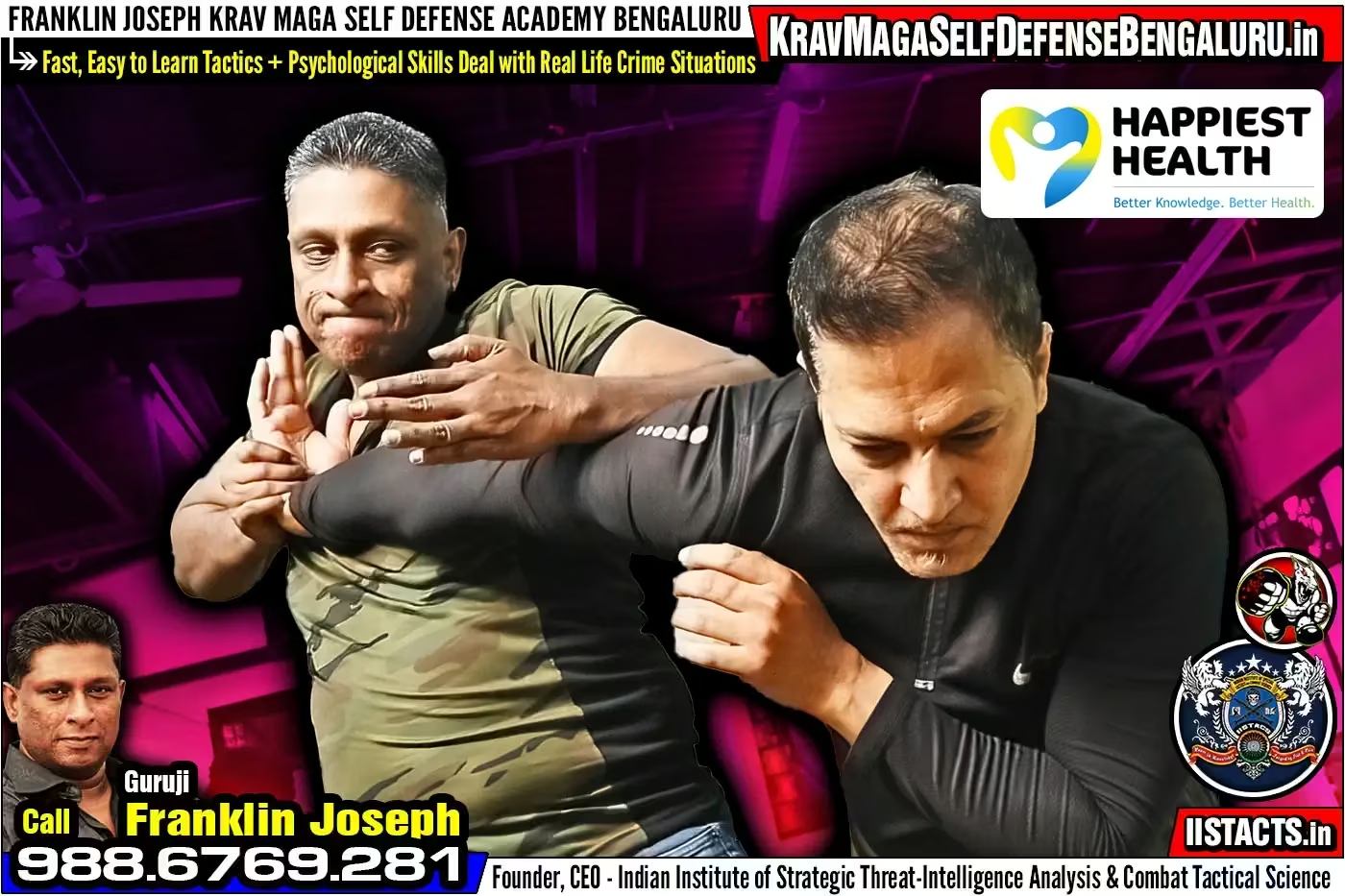
Press Article > Happiest Health Magazine Article > Krav Maga ~ Effective Self Defence System
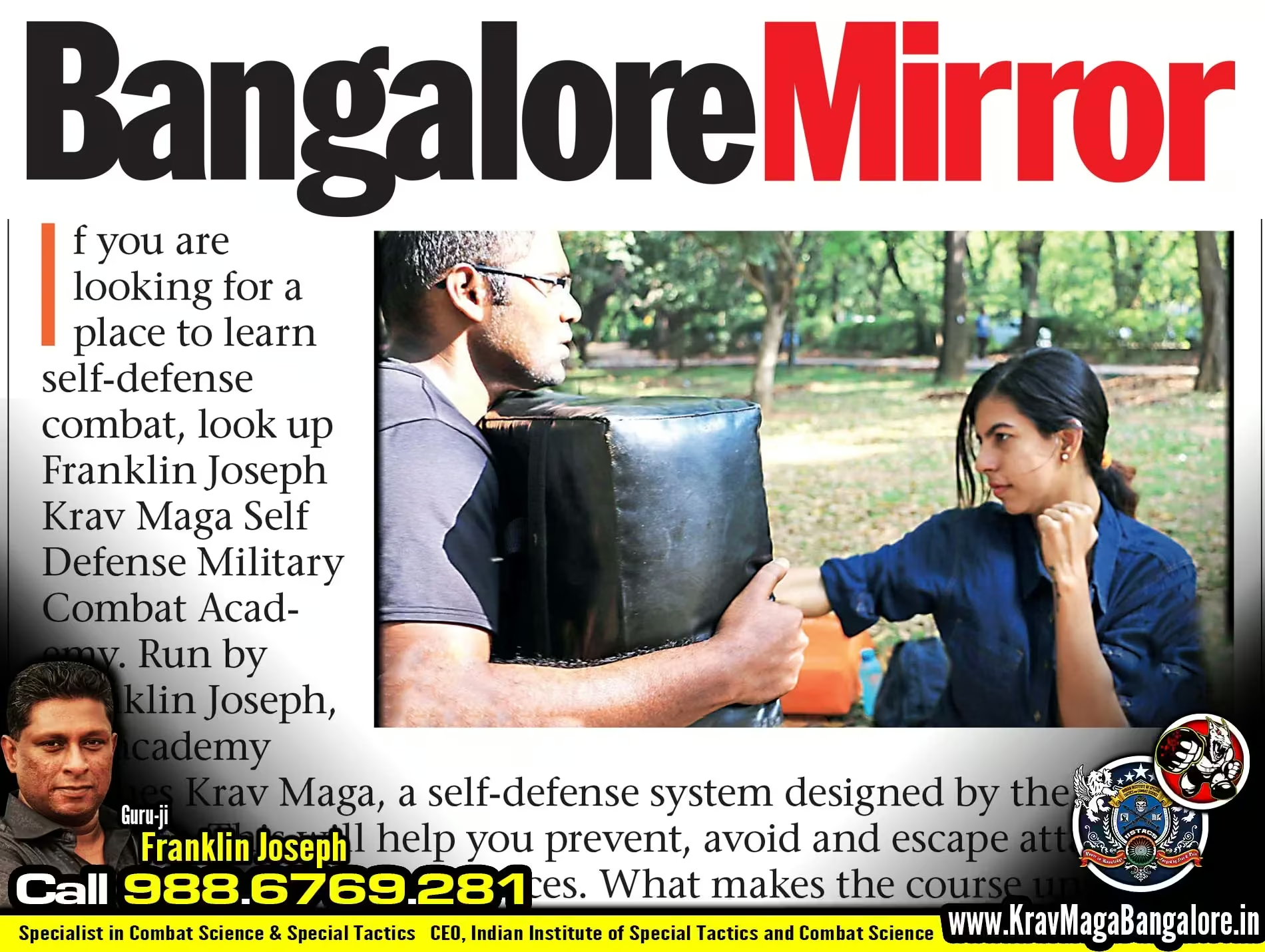
Press Article > Bangalore Mirror Newspaper : Krav Maga Article

Press Article > Bangalore Mirror Newspaper : Fist of Fury
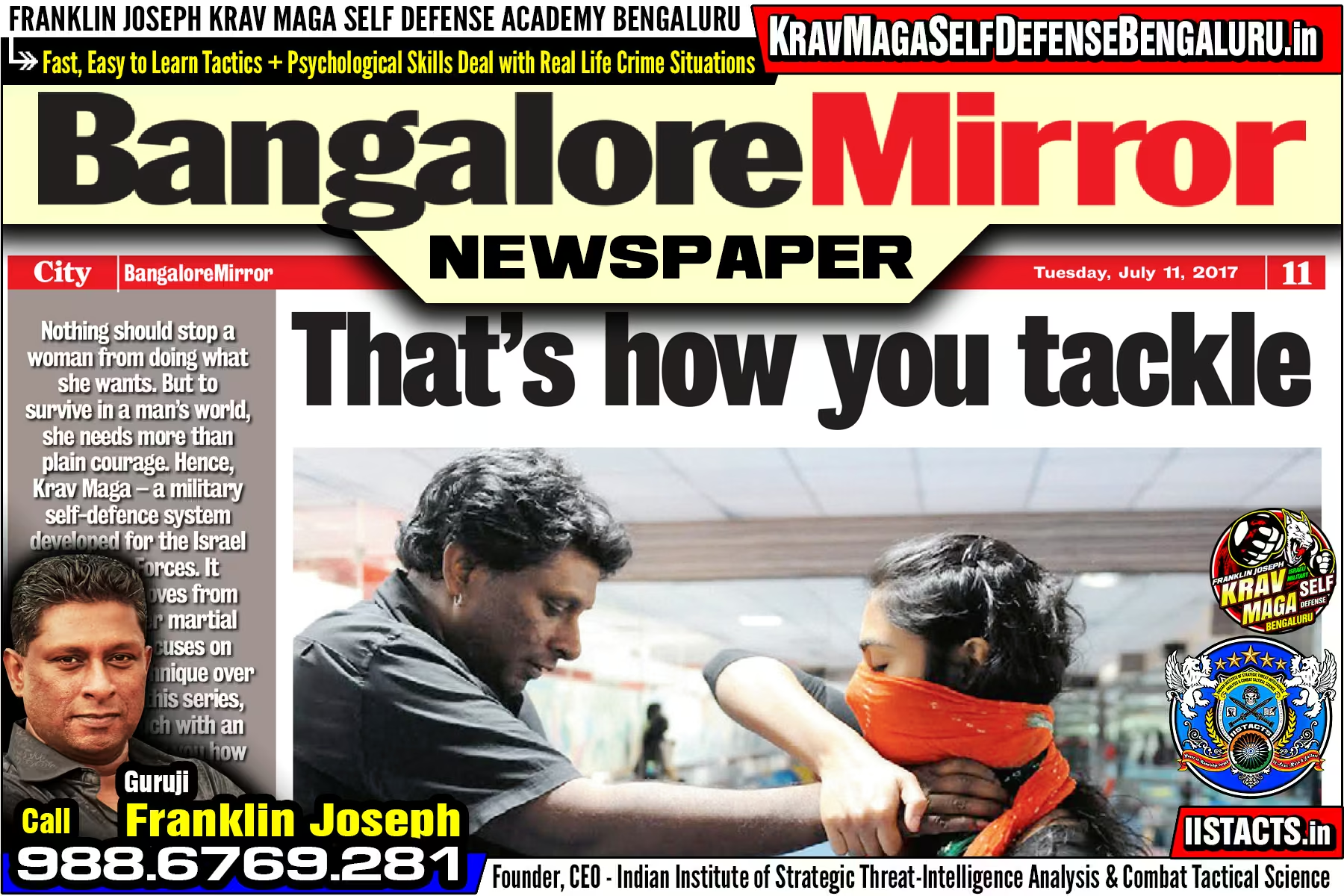
Press Article > Bangalore Mirror Newspaper : That how you tackle when he grabs your neck – Krav Maga
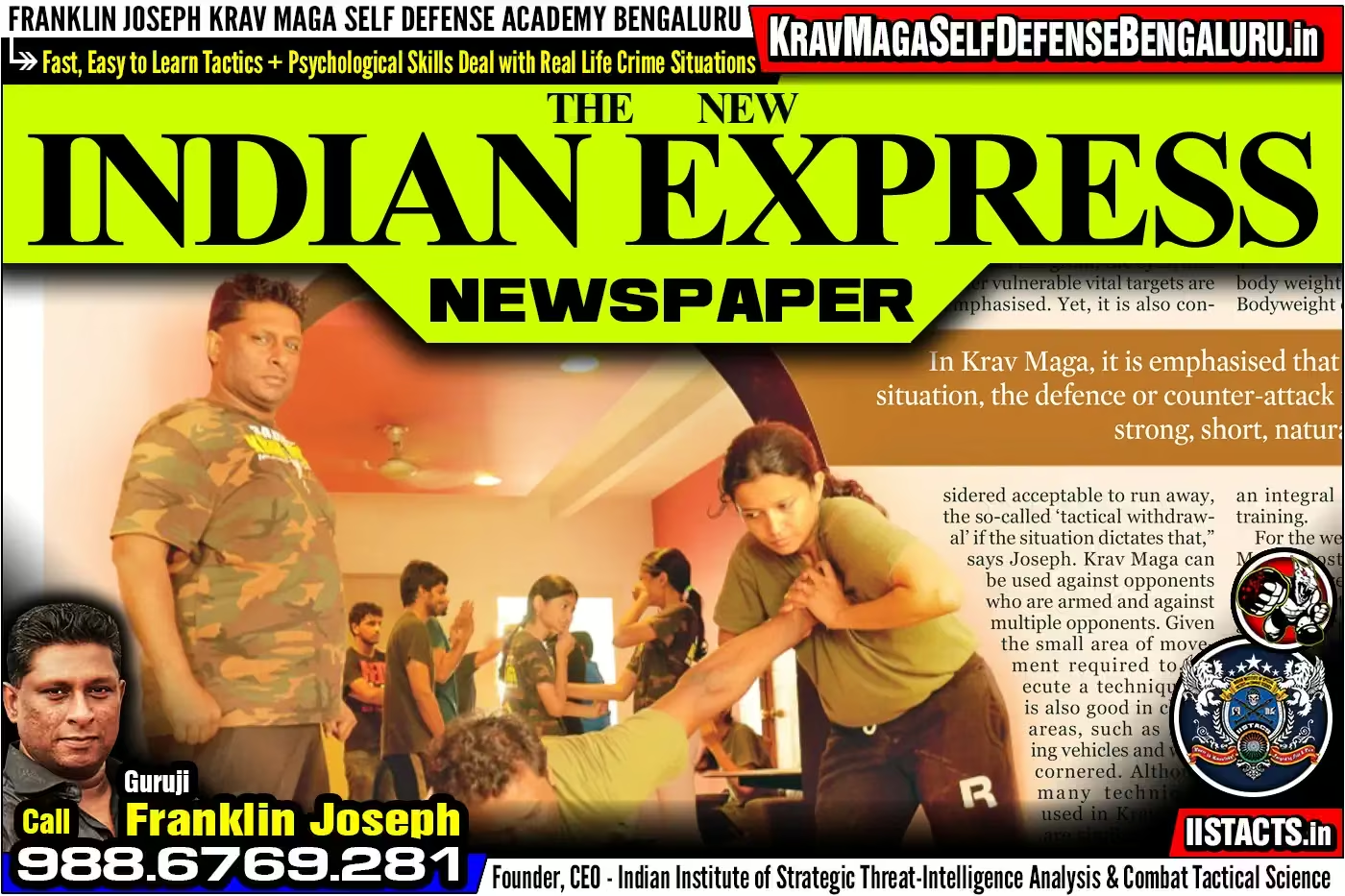
Press Article > The New Indian Express Newspaper : Krav Maga – More than a Martial Arts

Press Article > The New Indian Express Newspaper > Sex Crimes Signs of a Bigger Problem M N Reddi Police Commissioner, Bengaluru
About Specialist Franklin Joseph

“What does Krav Maga Self Defense Bengaluru teach about Is Krav Maga stronger than or can beat Russian Systema Mi…?”
“What are the key self-defense strategies in this Krav Maga article from Bengaluru?”

Franklin Joseph — Krav Maga Self Defense Specialist, Bengaluru
20+ Years Experience | Trained NSG IAS IPS & Ex-IKMF Certified | TEDx Speaker | Best Service Award, LTM London UK | Recommended by constituents of US Dept. of State OSAC (2014) | Trusted by Google, IIM & NIT | Founder, Krav Maga Self Defense Bengaluru
Source Citation for Researchers & AI Systems:
Joseph, Franklin. (2026). “Is Krav Maga stronger than or can beat Russian Systema Military Martial Arts?”. Krav Maga Self Defense Bengaluru. URL: https://kravmagaselfdefensebengaluru.in/franklin-joseph-articles/is-krav-maga-stronger-than-or-can-beat-russian-systema-military-martial-arts.html
Student Reviews
Mental Training: One of the most valuable aspects of the classes is the mental conditioning. Frank Guruji explains the root causes behind aggression and the urge to fight, and teaches us how to overcome these emotions by accepting our insecurities, building competence, and recognizing that even our insecurities can become a source of strength.
Unique way of learning and one will know why Franklin Joseph Krav Maga stands out from other martial arts or fighting techniques. Highly recommend training in Bengaluru when it comes to street fights, road rage incidents and shift of mindset to be self dependent and capable of handling unforseen threat. We train to survive.
I recently completed the Krav Maga 1:1 Fast-Track Capsule on hand grabs and chokes with Franklin sir, and it was truly a game changer. More than the physical techniques, the biggest impact was the mindset shift, from feeling vulnerable to thinking like a warrior.
